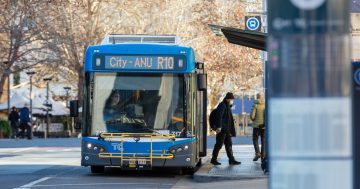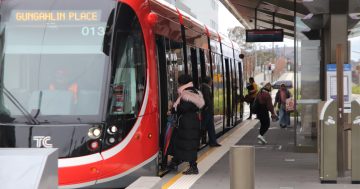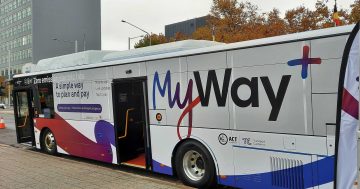

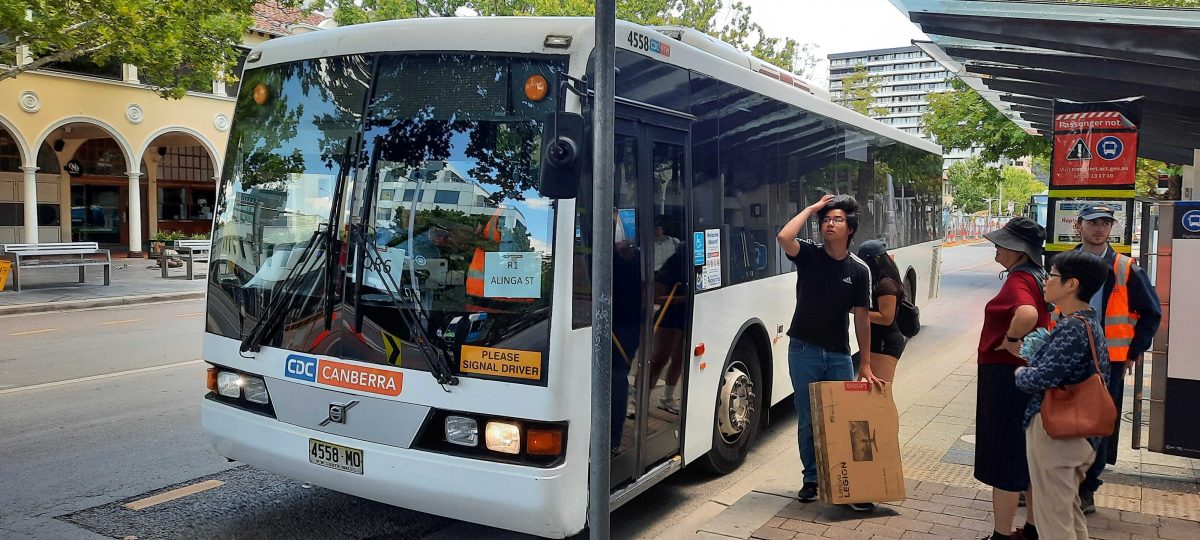
A CDC Canberra bus doing the “light rail run” at the city interchange. Photos: Ian Bushnell.
Transport Canberra has been urged to lay on more buses to replace light rail services to and from Mitchell interrupted by construction works for Stage 2A in the city.
Monday (12 January) was the first day of light rail disruptions to allow works to connect the existing light rail network to the new extension at the intersection of Northbourne Avenue and Alinga Street, including the laying of track.
The suspension of light rail services between Sandford Street and the city will continue to Friday 23 January, and platform changes at the City bus interchange to 1 February.
Public Transport Association of Canberra chair Dr Amy Jelacic said reports this morning were that the private buses hired to transfer passengers from light rail had filled rapidly and commuters further down the line had to wait for following buses.
“Absolutely poor planning! I’ve been waiting for 30 minutes at Ipima St, but I couldn’t get on the bus as five fully packed buses passed by,” was one comment on the Transport Canberra Facebook page.
Another passenger on one of the morning peak buses from Well Station Drive told PTCBR that the CDC bus was small and it was standing room only into Civic.“Bus stopped at Dickson, let a few people off, and quite a number of people forced their way on to already full bus, even after the driver told people to stop boarding,” the passenger said.
“It was most certainly overfull by the time it reached Civic – hopefully this is just first day hiccups, and it’s certainly lucky that it’s cooler today, as the air con struggled to keep up this morning.”
Dr Jelacic said it appeared that the buses were not travelling at the same frequency as light rail services as promised.
“I am hearing that the buses are coming at a relatively low frequency compared to light rail vehicles, when we were promised that they’d be coming at an equal or higher frequency,” she said.
“The buses are filling up really fast at the stops, so then when they come down into Civic, they’re getting really full, so it’s very hard for passengers closer into Civic to actually get on a rail replacement bus.
“That’s concerning and I trust that some of those day-one issues will be ironed out.”
An ACT Government spokesperson said rail replacement buses were scheduled to run at about double the frequency of regular light rail services.
During the morning peak this was every 2.5 minutes, not including the time delays due to traffic congestion.
“Each rail replacement bus has a third of the capacity of a regular light rail vehicle, which at the scheduled frequency, is sufficient to manage customer demand,” the spokesperson said.
“All rail replacement buses as well as standby buses were on the road to keep passengers moving today. Rail replacement buses stop at all rail replacement stops, however if a bus is full, they must not pick up more passengers.”
Transport Canberra would continue to monitor rail replacement buses and traffic throughout the closure period.
Delays were observed during the morning and afternoon peak periods due to congested traffic at bottlenecks along Northbourne Avenue near Swinden Street and Alinga Street.
The decision to undertake a construction blitz throughout January on the light rail project was made to minimise further disruptions to the traffic network later in the year, when traffic volumes would increase and the Commonwealth Avenue Bridge project would be in full swing.
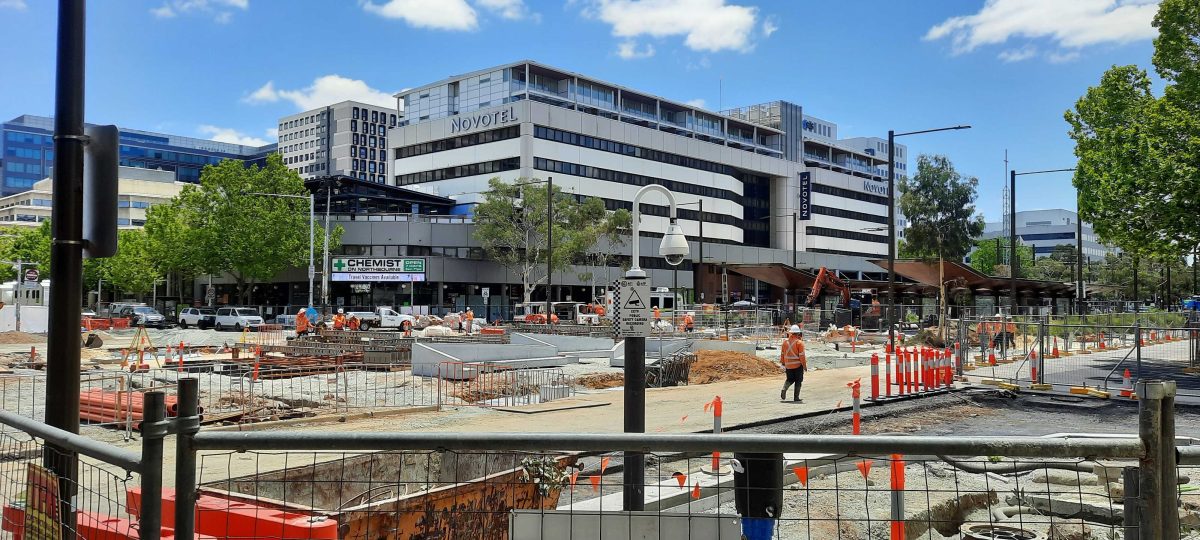
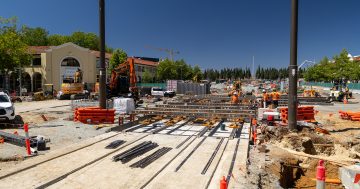
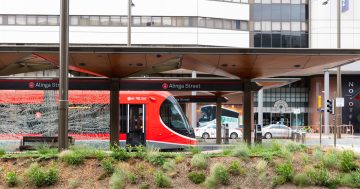
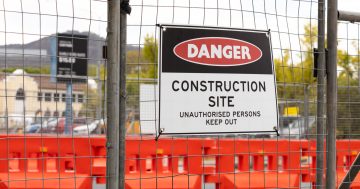
Stage 2A construction work near Alinga Street light rail station.
The replacement buses, operated by CDC Canberra, run between Alinga and Sandford streets in Mitchell, and continue to Well Station Drive.
Transport Canberra says the easier option is to transfer to a bus from Well Station Drive.
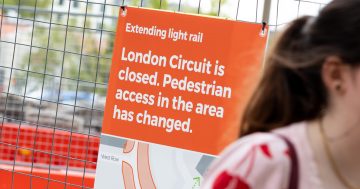
At the City bus interchange, platforms 1, 2, 3 and 4 are closed and alternative arrangements in place.
Dr Jelacic said PTCBR had requested more signage at the interchange to assist passengers, although there had been plenty of Transport Canberra staff on hand to advise and guide people.
“The City interchange bus platform changes appear to be settling in pretty well, and there were a lot of Transport Canberra and CMET (Canberra Metro) staff out today chatting to people, so I thought that was really positive to see,” she said.
“I’ve also asked for more signage to go up in the area, and that’s starting to appear, which is good.”
But Dr Jelacic said concerns remained about the adequacy and effectiveness of government communications on the disruptions to the network.
She would welcome messaging, after disruptions such as these, that would help people retain confidence in public transport and not resort to using their cars.
“It would be really important for the ACT Government to communicate better, to just let people know what’s happening,” she said.
“One of the issues right now is that communication about disruption is often not great, and I’m really encouraging them to do better with that.
“But then, when everything’s back to normal, people also don’t understand that, and we get ongoing issues with people thinking, ‘Oh, what’s going on?'”
Dr Jelacic said she was in active discussions with Transport Canberra, Infrastructure Canberra, and CMET and the minister’s office on how messaging could be coordinated better.
She said people were tolerant, but their patience wore thin when they had to search hard to find instructions or information to get where they needed to go.
“They just want easy and digestible information, presented to them in a way where they don’t have to be searching or working really hard to find it,” Dr Jelacic said.
She said this included using all available channels, websites and clear signs at platforms and other key areas.
A City and Environment spokesperson said signage, including wayfinding maps and online links to more detailed information, was developed and installed before Christmas.
This was supported by communications on web, social media, e-newsletters, radio and PA announcements in the city bus interchange precinct.
From 5 January, Transport Canberra had installed larger signs and more wayfinding.
An ACT Government spokesperson said work to connect the existing light rail network to the Stage 2A extension required switching off power to a large portion of the existing network and having full access to the light rail corridor between Alinga Street and Sandford Street, so it’s not possible to safely operate light rail during this period.
Construction crews were also installing a new traction power substation near the Swinden Street light rail stop to help power light rail vehicles en route to Commonwealth Park.