
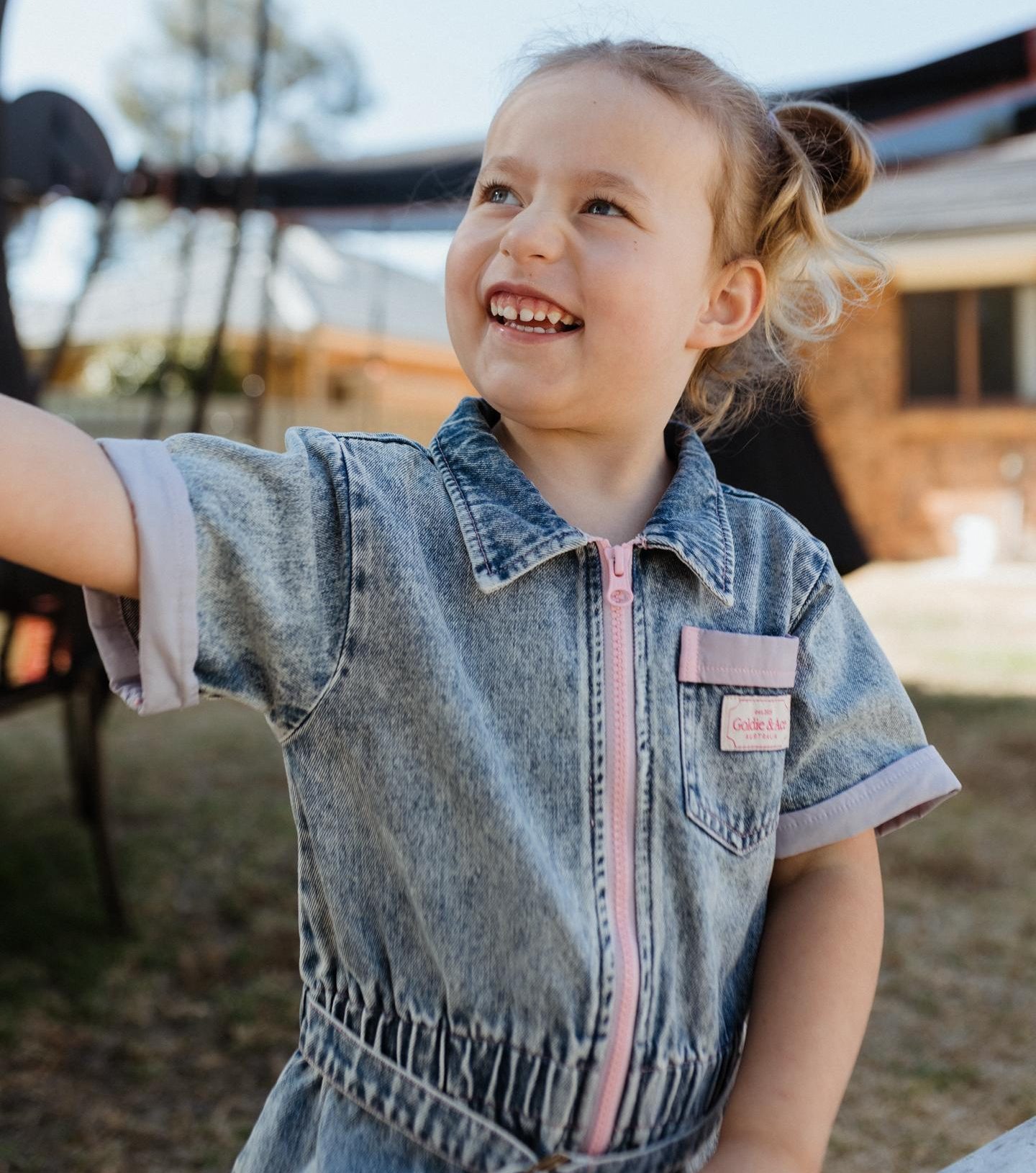
Sage’s mum and dad believe she is the first Australian to be diagnosed with the genetic disease. Photo: Hayley Sefo/HPW Photography/Canberra.
Sage is like any other four-year-old girl. She’s quick to smile, loves jumping on the trampoline and going to the beach.
Unlike most others, she lives with a rare genetic disease.
Mum Lauren Geatches had a “very textbook, healthy pregnancy” with her “fantastic” daughter, but some signs emerged in the first week after mum and bub came home.
“What that looks like in reality was some really, really subtle physical signs,” she says.
“Having another child, there were some very subtle differences in Sage’s body that weren’t family traits. They weren’t the same as her brother, even though they look remarkably similar.”
Those differences were dysmorphic markers, differences in body structure that can signal a condition.
After a nine-month wait for test results, Sage was diagnosed with NEDDFL Syndrome (neurodevelopmental disorder with dysmorphic facies and distal limb anomalies), a neurodevelopmental condition that results from a spontaneous mutation on her 17th chromosome.
It’s a de novo mutation, meaning it wasn’t inherited from either of her parents.
“It took us three years from that initial 10-day mark, when my intuition kicked in, and I started documenting all of the evidence that I had around both the physical signs and the developmental signs,” Lauren says.
“It took quite a long time to navigate the system (first in Canberra and then in Sydney), to actually push all the way to get the genetic testing done.”
Her parents believe she is the first Australian to be diagnosed with the disease.
Lauren says the condition affects several aspects of Sage’s life, including her fine motor skills, social cognition, and communication.
“We call it a constellation,” she says of her daughter’s symptoms.
“We like to say that she sees the world a little differently, that she kind of plays in her own way. She just needs a lot longer and has to work a lot harder to master any new skill.”
She started to receive therapy when she was 10 months old and has had an NDIS plan for several years.
“It became obvious quite quickly that Sage was developing in an atypical way – she wasn’t meeting those normal developmental milestones.
“I spent dozens, probably close to 100 hours researching … [I was] trying to find the one disease that pulled together what we call the constellation of symptoms and traits that Sage has.”
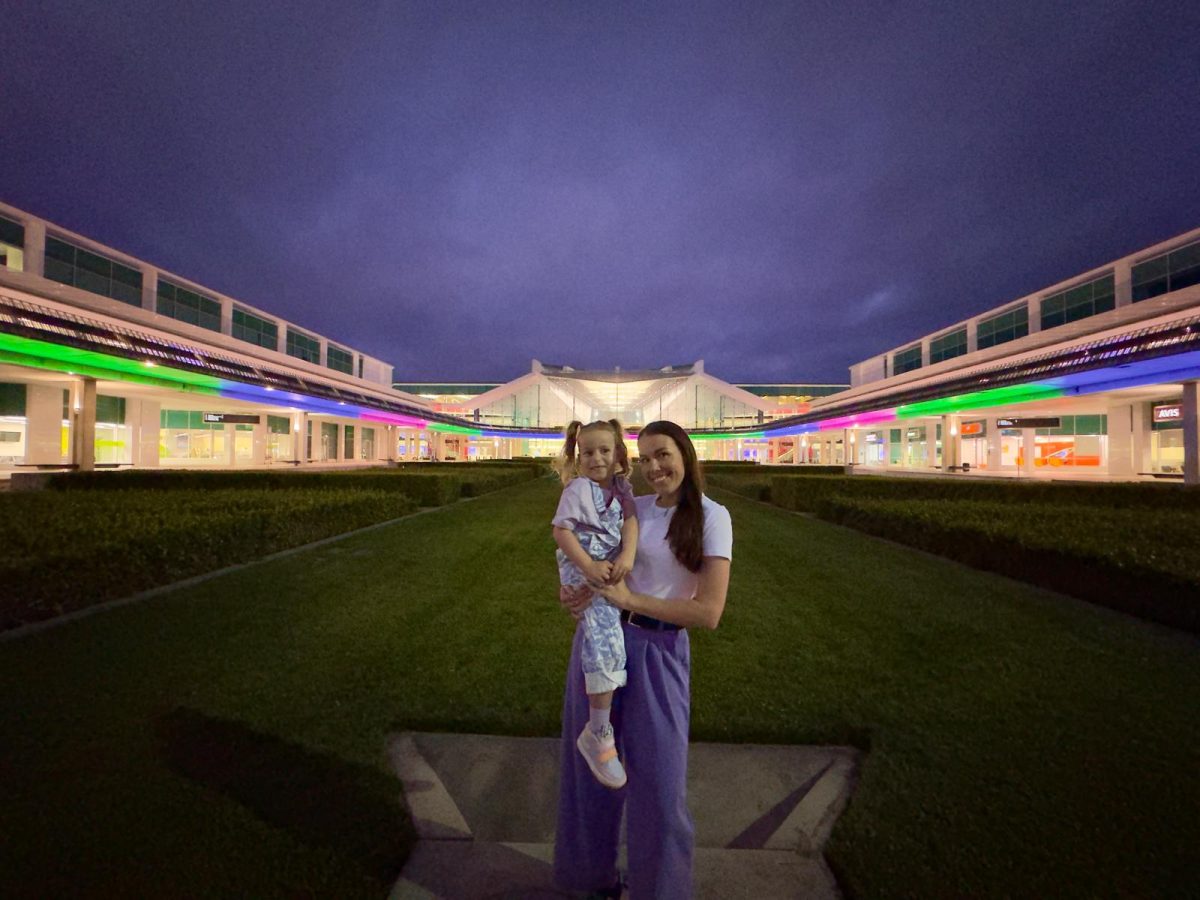
Canberra Airport is just one of the landmarks being illuminated to mark Rare Disease Day this Saturday (28 February). Photo: Tim Fulton.
Lauren, who left her job in health policy after Sage’s diagnosis, has used her professional experience to navigate and inspire a new career.
“It slowly dawned on me that if we wanted to kind of have information and start to do some advocacy, that would have to be led by the patient advocacy group, indeed by parents,” she says.
Lauren is the founder and inaugural executive chair of BPTF Families, an Australian-based not-for-profit that provides resources and information to other families with the same mutation.
She has also been named an ambassador for Rare Voices Australia (the national peak body for Australians living with a rare disease).
She and Tim Fulton, another Canberra-based rare disease advocate, organised for the Canberra Airport, National Carillon, the Royal Australian Mint, National Museum of Australia, light rail stops and the Malcolm Fraser Bridge to be illuminated this week in recognition of the estimated two million Australians living with a rare disease.
Lauren and other rare disease advocates from across the country will visit Parliament House in March and a picnic will be held at Bowen Park near Lake Burley Griffin from 10:30 am on Saturday (28 February) to mark International Rare Disease Day.
The advocacy work is part of a push to build a community for people living with a rare disease (and their families), who can struggle to find support and awareness of their conditions.
Lauren says a rare disease looks different for each family, but believes that support is key so they’re not left feeling isolated.
“Part of the challenge with rare conditions is that if you go to a quick GP appointment or even a pediatrician appointment, you need someone willing to look at the whole picture, because a lot of the things that Sage has challenges with seem unrelated,” Lauren says.
“They seem like a laundry list of problems, and you go, ‘Well, you know, this can’t be related to that – they’re completely different issues’ … but it’s an umbrella.”
You can find more information and resources about BPTF gene mutations at BPTF Families.