
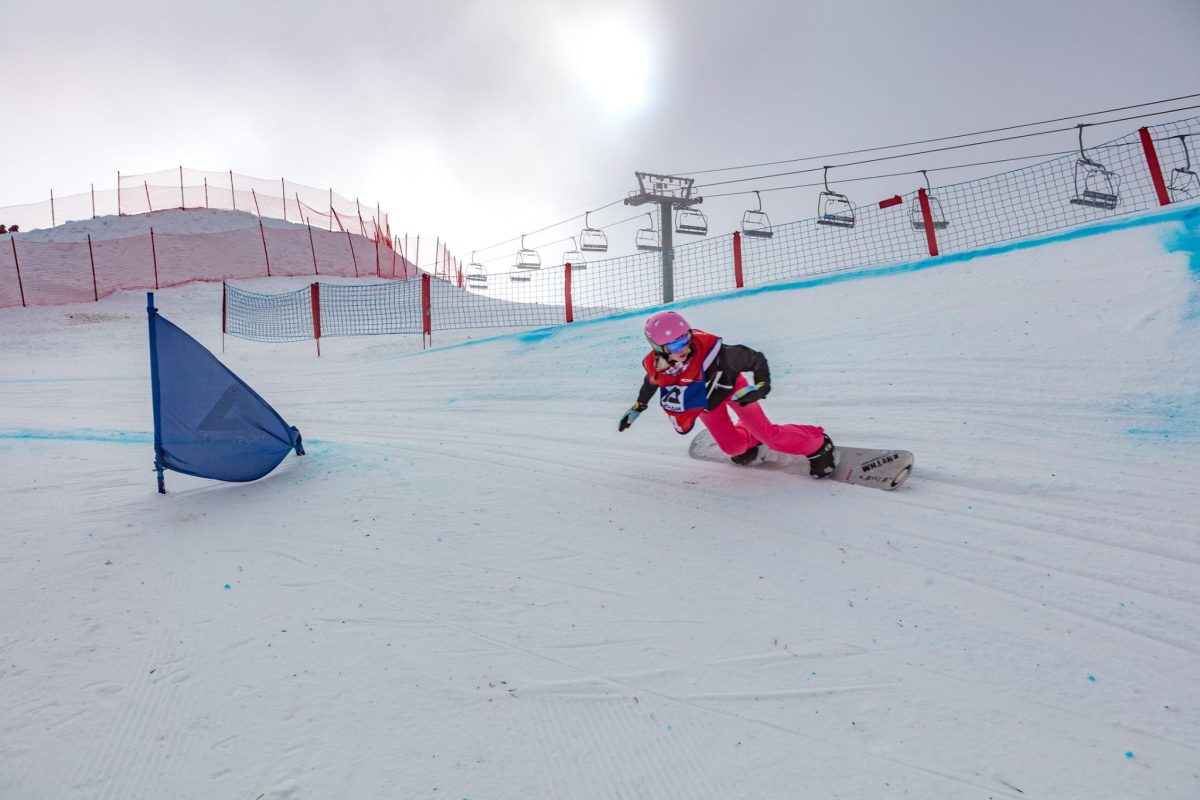
Josie Baff, 23, from Jindabyne, heads into her second Winter Olympics in women’s snowboard cross as one of Australia’s top medal contenders. Photo: Snow Australia Facebook.
With the Milano‑Cortina Winter Olympics set to start on 6 February, Australia has already arrived in Italy with one of its strongest winter sport contingents ever – and Southern NSW is right at the heart of it.
From Canberra to the Snowy Mountains to the NSW South Coast, local athletes who grew up chasing snow across limited seasons, enduring long drives to Perisher and Thredbo, are now anchoring Australia’s medal hopes in aerial skiing, moguls, snowboard cross and halfpipe events.
Laura Peel, 36, born and raised in Canberra, is a veteran freestyle skier competing in her fourth Olympic Games in the women’s aerial skiing event.
In aerials, athletes launch off steep jumps, flipping and twisting up to 50 feet before landing on sharply angled slopes, with scores based on difficulty, execution and landing.
Peel is a two-time world champion and three-time Crystal Globe winner – the latter awarded to the skier with the highest overall points across a world cup season.
She has also recorded 14 world cup victories and 29 podiums, and narrowly missed medals, with fifth-place finishes at the 2018 and 2022 Olympics.
Peel remains one of Australia’s strongest medal prospects, though her campaign has been marred by a knee injury at a pre-Olympics training camp.
Her 2026 Olympic campaign begins in the qualifiers on 17 February at the Livigno Aerials & Moguls Park.
Making his Olympic debut in aerials is fellow Canberran 21-year-old Reilly Flanagan, who now calls Noosaville home.
Like Laura Peel, Flanagan transitioned from gymnastics to freestyle skiing and has quickly made his mark internationally, including a mixed team world cup bronze in Ruka, Finland, in December 2023, alongside Peel and Abbey Willcox.
Look for him in the men’s aerials qualifiers on 17 February.
In men’s moguls, Cooper Woods, 25, born in Cooma and now based at Pambula Beach, returns for his second Olympics after finishing sixth at Beijing 2022, the highest-placing Australian man in the event.
Moguls is a freestyle skiing discipline in which athletes race down a mound-filled course while performing two aerial tricks, judged on turn technique, speed and aerial execution.
Woods has continued to shine on the world cup circuit, claiming silver at Waterville Valley in 2024, multiple top‑10 finishes and a dual moguls top-five at Livigno last season.
His 2026 campaign begins with qualifiers on 10 February at Livigno.
Jindabyne’s Charlotte Wilson, 20, makes her Olympic debut in women’s moguls.
Ranked among the world’s top 20, she has already made her mark internationally with a top‑10 world cup finish at Idre Fjäll, fifth in Waterville Valley and seventh at the 2025 world championships, including a dual moguls gold on the Livigno Olympic course.
Charlotte will start in the women’s moguls qualifiers on 10 February, closely watched by her sister Abbey Wilson, who makes her Olympic debut in women’s snowboard cross (SBX) two days later on 12 February.
Jindabyne has become a training ground for Australia’s SBX talent, with several athletes from the small Snowy Valleys town heading to Milano‑Cortina.
SBX is a high-speed, head-to-head race where four riders compete simultaneously down a course of jumps, rollers, and banked turns, with the fastest advancing to the next round.
Abbey Wilson, 19, is regarded as one of Australia’s most promising young SBX racers, having achieved multiple top‑10 world cup finishes in 2024.
Adam Lambert, 28, also from Jindabyne, arrives in career-best form as the world number one in SBX, after claiming his first world cup gold in January, marking three consecutive podiums to close the season.
Across his career, Lambert has earned eight world cup podiums and a sixth-place finish at the world championships, building on previous Olympic appearances – 29th at PyeongChang 2018 and 22nd in the individual and 13th in the mixed team at Beijing 2022.
Lambert grew up in the Snowy Mountains, where he first stood on a snowboard as a toddler using custom bindings made by his parents.
Josie Baff, 23, born in Cooma and raised in Jindabyne, heads into her second Winter Olympics after debuting at Beijing 2022.
After winning gold at the 2020 Winter Youth Olympic Games – Australia’s first Youth Olympic snowboard cross title – Josie has since earned multiple world cup victories and 16 podiums, a 2023 world championship silver medal and mixed team world cup wins, including Australia’s first mixed team gold with Cameron Bolton.
She will compete in women’s SBX heats from 12 February.
Another Pambula Beach-based athlete, Valentino Guseli, 20, returns to the Olympic stage in men’s snowboard halfpipe, where riders are judged on difficulty, execution, height and landing as they perform flips and spins off the walls.
Guseli made his Olympic debut at Beijing 2022, finishing sixth as a 16-year-old, one of Australia’s best-ever results for a teenager.
Since then, he’s earned world cup podiums across halfpipe, slopestyle and big air, including halfpipe gold at the Calgary World Cup in January 2024 and a silver medal in halfpipe at the 2023 World Championships in Bakuriani, Georgia.
After a knee injury in 2025, he returned to competition with bronze in halfpipe at Copper Mountain in December 2025 and another halfpipe gold in Calgary in January 2026.
Known for his amplitude and technical range, Guseli also holds the world record for the highest air on a snowboard off a hip jump.
At Milano‑Cortina, Guseli will compete in men’s halfpipe qualifiers and finals from 19 February.
While he has previously competed in slopestyle – which combines jumps, rails, and technical tricks – and big air, where riders perform one major trick off a single jump, he is currently focusing on halfpipe.
If fit, he has said he would consider contesting all three disciplines, which would be historic, as no male snowboarder has ever entered three events at a single Olympics.
Australia has a modest but proud Winter Olympic history, with 16 medals to its name, mostly in freestyle skiing, snowboarding and short track.
The Milano‑Cortina Games run from 6-22 February, with the opening ceremony at 8 pm local time (6 am AEDT) and the closing ceremony on 22 February.
Original Article published by Edwina Mason on About Regional.