

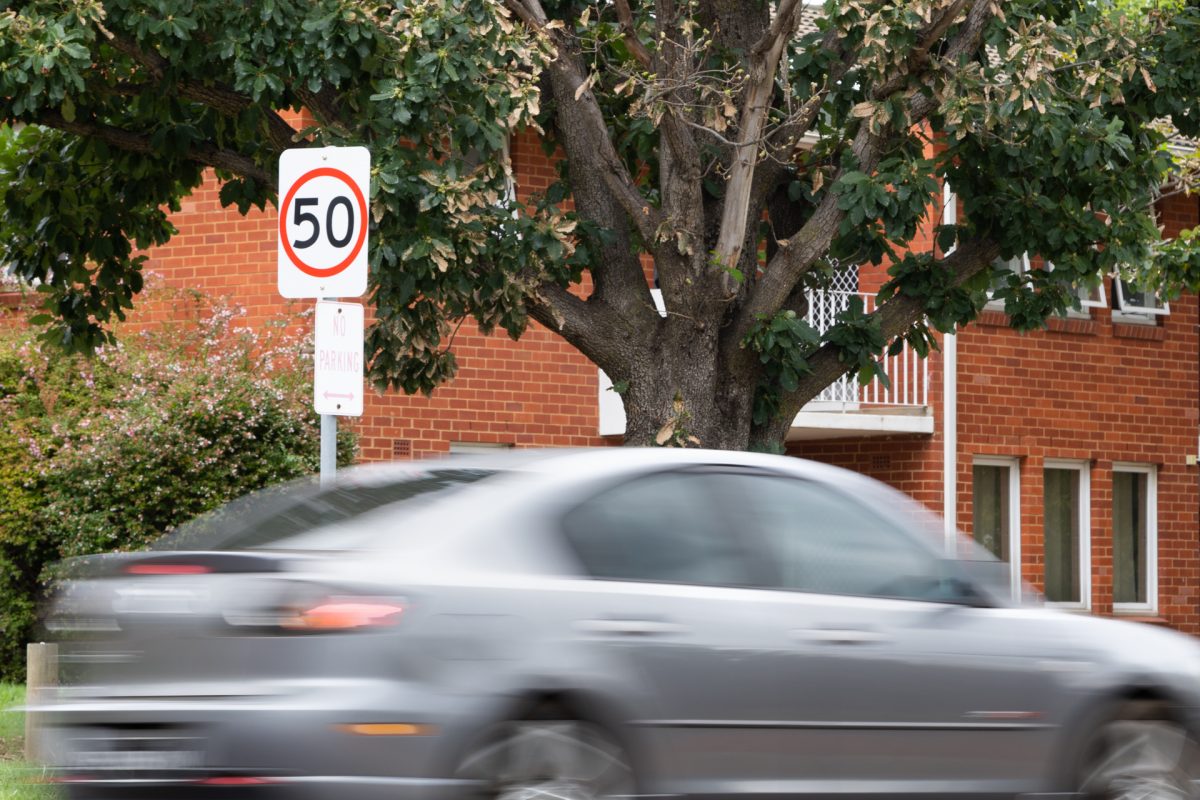
Some foreign diplomats and consular staff won’t pay traffic infringement notices. Photo: Michelle Kroll.
The Embassy of Spain still hasn’t paid a $67 fine from 1996, while an Embassy of Pakistan driver has an outstanding $2534 infringement for using a mobile phone behind the wheel.
Diplomats, embassies and mission staff are generally exempt from a country’s laws, as outlined in the Vienna Convention on Diplomatic Relations.
But traffic and parking infringements are excluded from this immunity status, meaning all diplomatic and consular staff, as well as their dependents, are expected to abide by Australia’s road rules.
ANU College of Law, Governance and Policy international law professor Donald Rothwell said a country’s parking rules and traffic laws probably weren’t issues that were front of mind when the Vienna Convention was adopted in 1961.
“Fines fall into a somewhat grey area as to whether they are a criminal law matter … or whether [it’s] an administrative matter, which then fall outside of the Vienna Conventions,” he said.
“There are [some countries] that take the view … in [their] interpretation of the Vienna Conventions, that ‘we’re not subject to this version of Australian and ACT law’.”
Prof Rothwell explained that straight-out parking fines could be interpreted by some as an administrative matter, as illegal parking (and related actions) create an “inconvenience” to other members of the public, whereas a traffic infringement can “pose, clearly, a threat to other members of society”.
“There are various gradations [in the severity of an incident] one needs to think about,” he said.
Any diplomat who is accredited to work in Australia is expected to comply with local laws, despite any immunity status. Many countries do want to be reputable and have a good standing with the Department of Foreign Affairs and Trade (DFAT).
But those that appear to be more disposed to breaking traffic and parking rules – and ignoring the subsequent fines – aren’t unique to Canberra.
“It comes with the territory of Canberra being the capital [of Australia] … it’s not an unexceptional practice around the world,” Prof Rothwell said.
“You’ll probably find those repeat offenders are representatives of governments who, around the world, flaunt parking and traffic [rules] … there’s a culture there.”
However, keeping track of which missions, diplomats and embassy staff break both ACT rules and pay the fines can be useful for DFAT.
“It keeps tabs on those who are law-abiding and those who are not,” Prof Rothwell explained.
As the data is publicly available, it could also help explain to residents of suburbs that are flush with embassies and popular with their staff – such as Yarralumla, Deakin, Forrest and Manuka – why parking might sometimes feel so impossible.
According to the DFAT website, missions, posts and their staff are expected to pay all fines “promptly” (unless they plan to contest the infringement).
“DFAT cannot intervene to seek a waiver or cancellation of infringement notices,” its website stated.
As of October 2025 there were 66 outstanding parking and traffic fines from embassies, missions and consular staff.
The total amount unpaid is $63,076.
Fifteen embassies are named, while others are listed as “unknown” or are de-identified missions.
Offences include parking in a loading zone, stopping on a path or nature strip, using an unregistered or suspended vehicle, speeding and using a mobile phone while driving.
Mission and post staff can have their licences suspended if the licence holder accumulates “sufficient demerit points” or fines remain unpaid.
“Continuing to drive on a suspended licence would demonstrate a serious disregard for Australia’s traffic rules and could lead to a request for the individual’s withdrawal from Australia,” the DFAT website stated.
A person’s immunity to certain driving offences depends on their status.
An ACT Government spokesperson confirmed it had moved to suspend the licence of a mission or diplomat in the past, but did not go into further detail.
“Non-payment of road transport infringement notices in the ACT may result in licence suspension, cancellation of vehicle registration, or the revocation of a person’s right to drive in the ACT,” they said.