

25 November 2025

The old building standard that's caught up with at least one Gungahlin homeowner

| By James Coleman
Join the conversation
19

Plumbers discovered Nick Davies’ stormwater pipe goes nowhere. Photo: Nick Davies.

Every time it rains, Nick Davies’ backyard becomes a swamp. It doesn’t have to rain for 40 days and 40 nights, either – 40 minutes of good rain is enough.

All of his house’s downpipes spew water. The lowest corner of the yard fills up to a depth of about 10 cm. The property’s wooden fences are all rotting in sediment, washed down from all the property’s high points.

It’s been this way ever since he moved into a street in Amaroo, Gungahlin, seven years ago. And judging by the existing mesh on the house’s gutters, the previous owners also struggled with the same flooding problem.

READ ALSO Massive blowout to cost of the BoM’s bungled new website sparks outrage

“Pretty much from day dot, we’ve been having problems with our stormwater, downpipes filling up and backflowing until they flood our backyard,” he says.

“When you look at our property, the right-hand rear is pretty much always dead – everything we’ve planted and tried to grow has died. And it’s the same on the neighbour’s side. It just gets pounded with water.

“I was thinking, ‘All right, the gutters must be blocked’, so we went through the process of cleaning them all out.”

But after years of investigation and plumbing work, he’s found the root problem. And these Amaroo residents might not be the only victims.
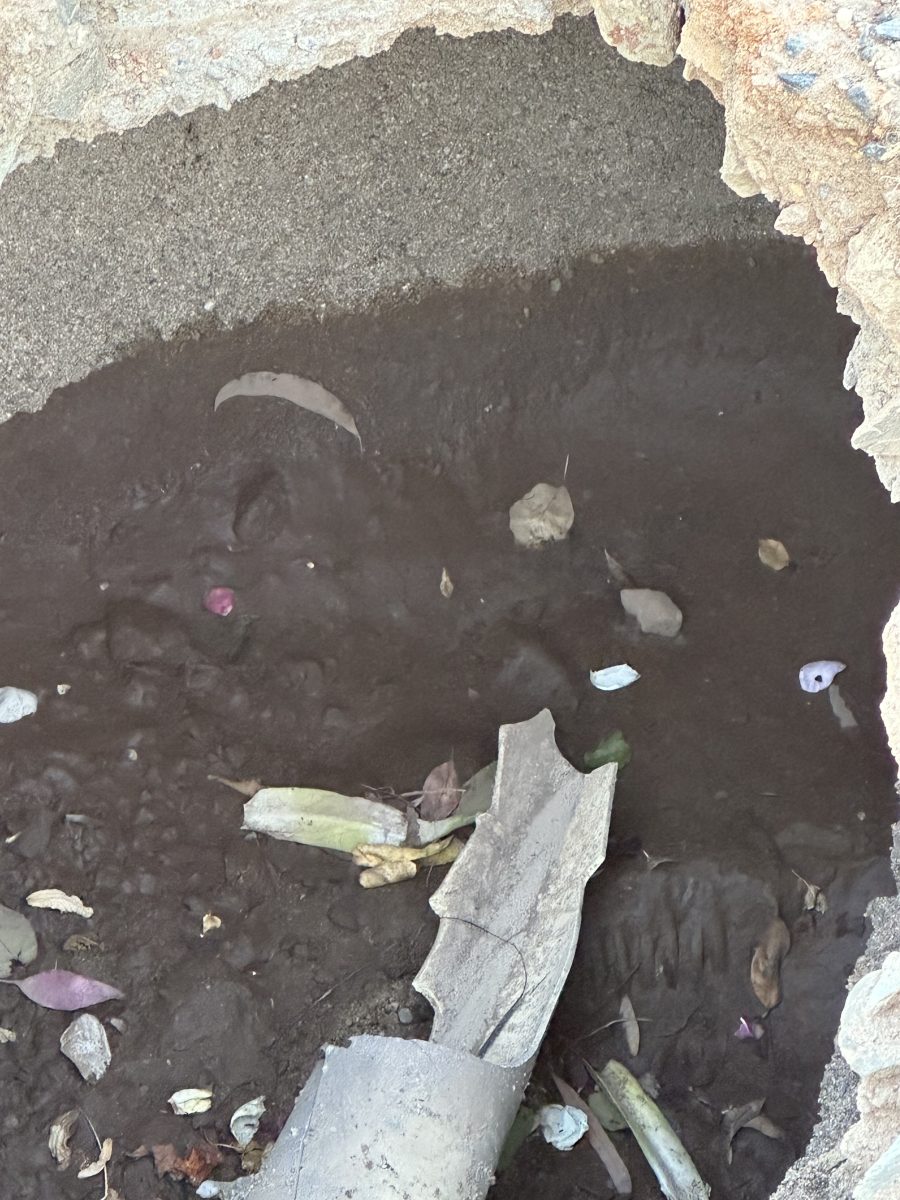
Water rushing down the pipe – with nowhere to go – has carved out a hole. Photo: Nick Davies.

It turns out that in 1999, when the street was built, his property’s stormwater pipe was not connected to the street’s main stormwater channel.

“The pipe had never been connected to the stormwater – it just stopped at the road. It was just going into dirt basically. The guy who came to look at it laughed and said he’d never seen anything like it.

“The stormwater mains run straight down the middle of the street, but they never connected the two.”

He’s not sure how widespread the problem is, but if you live in Amaroo – or any of Canberra’s pre-2000s suburbs – and your stormwater system is constantly overflowing, he says it might be worth checking.

“Nothing I did could stop the flooding … I’ve gone through two plumbers over the years, and concluded we maybe just didn’t have the right drainage on our property to deal with all the water.”
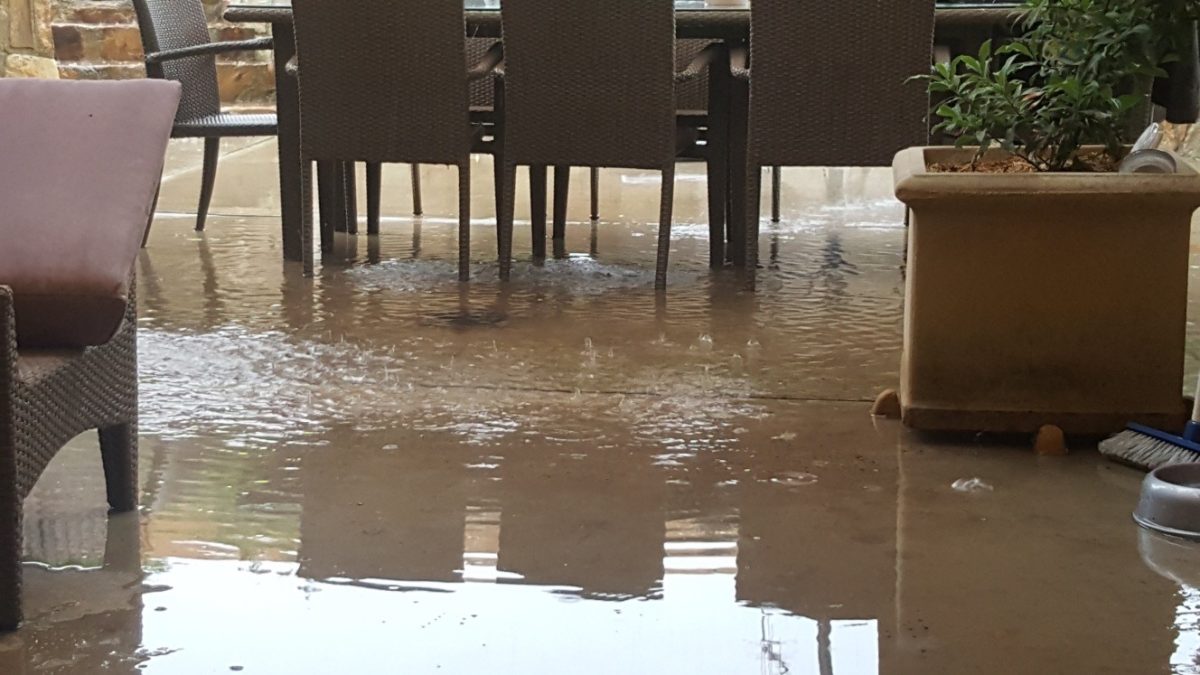
Flooding

Flooding in Nick Davies’ backyard. Photo: Nick Davies.

During the hunt, he forked out about $6000 to have an inspection point installed along the stormwater pipe’s route down the road, which involved removing several trees and digging a trench in his front yard down to about 1.5 metres.

According to the ACT Government, properties in newer suburbs are meant to be connected to the stormwater system at this inspection point (also called a “tie point”), which is installed on the boundary between private and public land.

As it is, the new inspection point has taken the pressure off Davies’ backyard by providing the stormwater with an outlet, but it hasn’t solved the bigger issue.

“It now floods at the inspection point,” he says.

“I’m just dumbfounded how it was approved. Obviously, I’m just one house on the street, but we were all built at the same time, so I’d love to know if other people are having issues too.”

READ ALSO Probe investigates if airport road project will protect critically endangered reptile

In response to questions, an ACT Government spokesperson told Region the problem can be traced to lower building standards in place at the time.

“The reason why this happens is varied,” they said.

“In original homes built in older suburbs within the inner south and north, there was often no connection provided in accordance with standards of the time. In other cases, connection may be via the kerb and gutter, rather than direct to the pipe network.”

An image of a suburban park with the text 'Amaroo - Such a Beautiful Place' overlaid on top

Amaroo was gazetted on 18 October 1991, and means “a beautiful place” in Nyoongar. Image: James Fletcher.

The government suggests that others suffering similar problems first engage the services of a plumber, who can also “assist with the process of connecting the homeowner’s stormwater to the public stormwater network” with a tie.

“The stormwater tie can be connected via a pipe to a stormwater main, to the back of a sump or to the kerb of a street.”

To start the process and find out whether the issue is on private or public land, residents can also lodge an online enquiry via the government’s online maintenance request portal, Fix My Street. There’s an online form for residents to “apply for reimbursement for blockages and damages cause by ACT Government infrastructure” too.

For Davies, the issue has yet to be resolved – but he’s most annoyed he’s been left out of pocket.

“That’s something the government should have inspected and put in.”

Free Daily Digest

Want the best Canberra news delivered daily? We package the most-read Canberra stories and send them to your inbox. Sign-up now for trusted local news that will never be behind a paywall.
Loading
By submitting your email address you are agreeing to Region Group's terms and conditions and privacy policy.

Join the conversation

19
All Comments
  • All Comments
  • Website Comments
LatestOldest
Geoff Piddington10:27 am 28 Nov 25

I had a similar problem involving a collapsed Terra Cotta tie-point connection. Despite camera evidence, ACT Govt refused to allow my plumber to replace the Terra Cotta pipe, instead insisting on a 2 meter hole and riser being installed, filling in the hole, and weeks later re digging the hole to install and reconnect the storm water connection. Must have cost the tax payer thousands.

When I had a new house built replacing another, the stormwater pipe from the old house was found to be blocked by tree roots. The storm water had been redirected into a dug gravel pit under the back grass. Possibly had been like this for years. This was only discovered when the new house was being built.
Also the person taking the old house away to be re-erected in the country, made the comment that the house had never been tethered down. Something else not done. The old house would have been built in the 1950s or 60s. An ex govie.

Victor Bilow2:37 pm 25 Nov 25

Some builders are always doggy, Storm water not connected is a big issue and the other big issue is the government housing projects that where built. The footing contactors called for the footing reinforcement mesh inspection and ounce the inspector left, they then moved the mesh to the next identical house footing. Many government houses sit on concrete without reinforcement mesh. Possibly private as well and these had been inspected.

All old houses with cotton covered electrical cables sitting in metal tubing throughout inner Canberra are a electrical disaster waiting to happen unless the wiring has been replaced.

Australian government should inform all residents in Australia regarding this situation.
This is what caused the deaths during the Rudd insulation scheme by using aluminium foil insulation sheets.

“In response to questions, an ACT Government spokesperson told Region the problem can be traced to lower building standards in place at the time.”
As apposed to the high standards our current trades are working to 😆.

Had a place in O’Connor, built in the 50’s. Had the overflows etc.
Dug up the line of the pipe and it went into a rubble pit, which had become a tree root pit.
So this sounds this property has a charming reflection of traditional Canberra design.

My old house also built in the same era, also had the stormwater going to a gravel pit.

Ross of Canberra9:53 pm 24 Nov 25

There’s lots of stuff buried that is sub-standard. Many years back I was told about footpaths being consistently laid with an insufficient thickness of concrete. Surely you notice how many paths are cracked and undulating revealing the thin slab.
Empower residents to report and then hold contractors liable.

1999? Good God, Kate Carnell and Brendan Smyth (pronounced with a short “i” of course) have come back to haunt us!

No a dishonest tradesman who took no pride in his work and most likely a dishonest building inspector!

You may be right Elf but I suspect it was the lax building regulations that existed at the time. I also think it had to do with the then Liberal government scrapping the public certification system and replacing it with a privatised model.

Potential conflicts of interest as well as lax and poor building practices all combined and created the problems we are seeing today.

If the previous owners knew of the problem aren’t they required to disclose on sale.
Plumbers usually can send a camera down to check or get the government to pay if a problem is found not on the properly.

Lets hope the sewerage was connected.

Capital Retro4:56 pm 24 Nov 25

When you purchased the place the mandatory property inspection report should have revealed this problem.

Those reports are a useless expense. I would be taking action against the people who did the “report”.

They don’t include checking the plumbing to the street.

Daily Digest

Want the best Canberra news delivered daily? Every day we package the most popular Region Canberra stories and send them straight to your inbox. Sign-up now for trusted local news that will never be behind a paywall.

By submitting your email address you are agreeing to Region Group's terms and conditions and privacy policy.