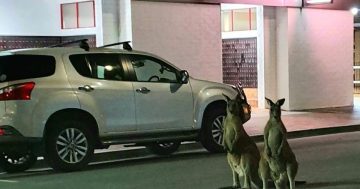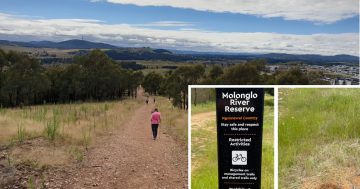

Virtual fences have been trialled across the country as a way to prevent vehicle collisions with kangaroos. Photo: ACT Government.
The ACT Government has rejected a call to trial virtual fencing on Erindale Drive, stating there was no “strong evidence” to suggest that it’s an effective way of reducing road accidents involving kangaroos.
There were 4464 macropod-related incidents reported in 2024-25 and the vast majority of the animals struck were kangaroos.
In a response to the petition (which attracted 1350 signatures), City and Government Services Minister Tara Cheyne said while collisions with kangaroos represented a “considerable safety, cost and animal welfare concern”, the data wasn’t there to support such a trial.
“[One NSW report showed such trials] have shown mixed success and the experimental design of some studies has been criticised,” she said.
“The report also notes that most claims of high success rates lack scientifically robust data. Based on current research, there is no strong evidence that virtual fences are an effective method for reducing wildlife-vehicle collisions.
“The report concludes that virtual fencing should not be trialled further in its current form.”
Ms Cheyne also said while ‘vision zero’ was an aim for the ACT Government, accidents involving kangaroos “seldom” resulted in serious injury or death to people.
The suggestion for Erindale Drive to be the trial location was also scrutinised.
Between 2018 and 2924, 23 crashes were reported along Erindale Drive (between Long Gully Road and Sulwood Drive). Six of those involved animals, and none required medical treatment.
In the same time period, Parks and Conservation rangers attended about 170 macropod-related incidents along the same stretch.
Ms Cheyne said the crash record didn’t indicate a “road safety concern” related to wildlife.
“While this location does experience a high number of kangaroo-vehicle collisions, there are other roads with higher collision rates,” she said.
“While virtual fencing may appear to be an attractive solution, and I can appreciate why the petition received such strong support, the available evidence does not yet provide a strong basis to warrant support.”
Underpasses and fencing have been installed along various Canberra roads to mitigate wildlife-related collisions, and options to reduce kangaroo collisions are being considered in the new Buru (Eastern Grey Kangaroo) Controlled Native Species Management Plan.
Virtual fences are usually solar-powered devices along roadways that emit high-frequency sound and light at night when a car approaches.
It’s different to the stock virtual fencing that’s recently been legalised in NSW.
Petition sponsor and ACT Greens MLA Jo Clay questioned why the government wouldn’t want to investigate the “non-invasive and relatively inexpensive technology” for itself.
“There are a number of success stories nationally, like in Eurobodalla, NSW, where a virtual fencing trial led to a 90 per cent reduction in kangaroo fatalities along a known hotspot,” she said.
“Canberrans asked for this trial to see if it works, and I think that is the best reason to run a trial.”
Ms Clay said the community would continue to advocate for such a trial in the ACT.