
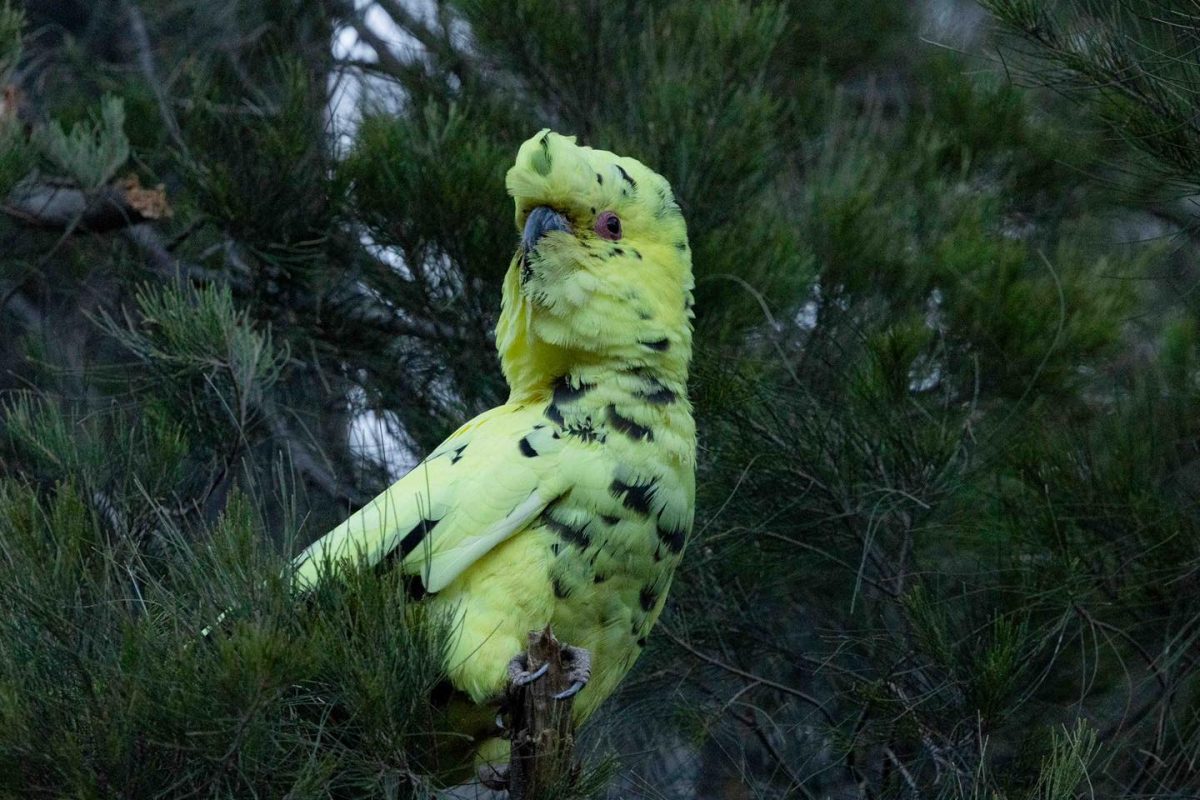
The bird’s location hasn’t been revealed for its protection. Photo: Eleanor Joy, National Parks Association ACT, Facebook.
What would normally be a deep black cockatoo has been spotted in an ACT nature reserve wearing bright yellow plumage – living proof of a very rare genetic condition in the bird world.
The photo, shared to the National Parks Association ACT (NPA ACT) Facebook page, showed a cockatoo with “big, irregular blocks of bright yellow with normal black feathers mixed in”.
The photographer, Eleanor Joy, noted it was “happily sitting in a tree with at least five to six yellow-tailed black cockatoos”.
“It was just like one of the family.”
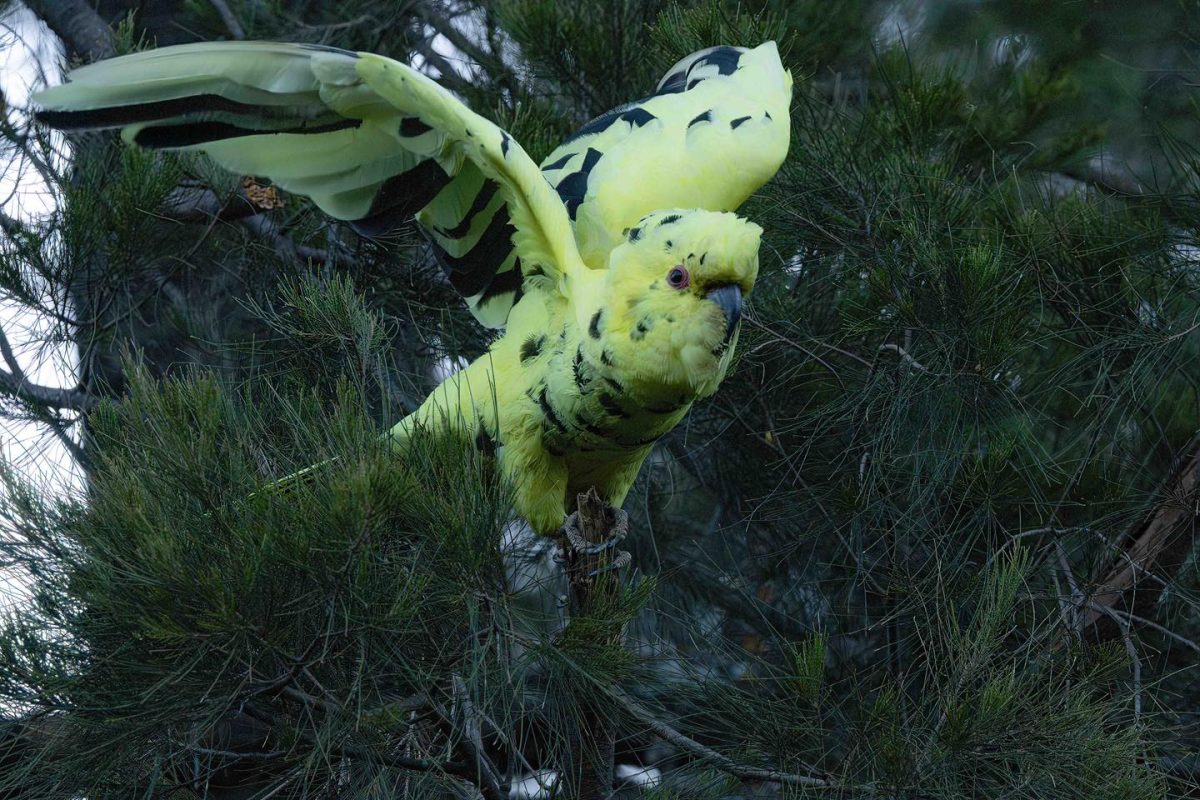
The cockatoo seems to get on perfectly well with others in its flock. Photo: Eleanor Joy, National Parks Association ACT, Facebook.
Commenters had various descriptions for it, including “a construction cockatoo in his hi-vis”, “pistachio choc-chip cockatoo”, and “kiwi fruit”. NPA ACT itself has dubbed it “Limoncello”.
The exact location was not mentioned, but it’s understood that they live in one of the ACT’s central nature reserves.
Kim Farley, president of local ornithology group Canberra Birds, says the cockatoo has a very rare genetic condition called “leucism”.
“Leuc, meaning yellow, and it’s kind of an umbrella term for a number of reasons why a bird could have a variation in plumage,” she says.
“It’s quite a rare condition. Some research in the US found that only 1 in 30,000 birds has this condition. Whether that’s the same in Australia, we don’t know because that research hasn’t been done, but it shows its rarity.”
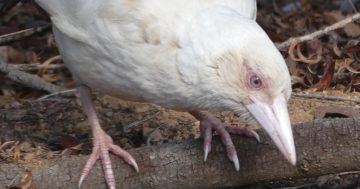
Leucism is different from albinism, where a creature’s body produces no or at least very little natural pigment, resulting in pink eyes and white fur or skin.
A leucistic bird has all the right pigments (or a normal amount of melanin), but they are inadequately fixated or fail to be deposited properly in the feathers. This means that leucistic birds have normal colouration of the eyes, bill, legs, and bare parts.
Unlike albinism, the condition doesn’t seem to affect a bird’s health or lifespan either.
“Other black cockatoos are not going to ostracise it or shun it – it will just be a normal member of the group.”
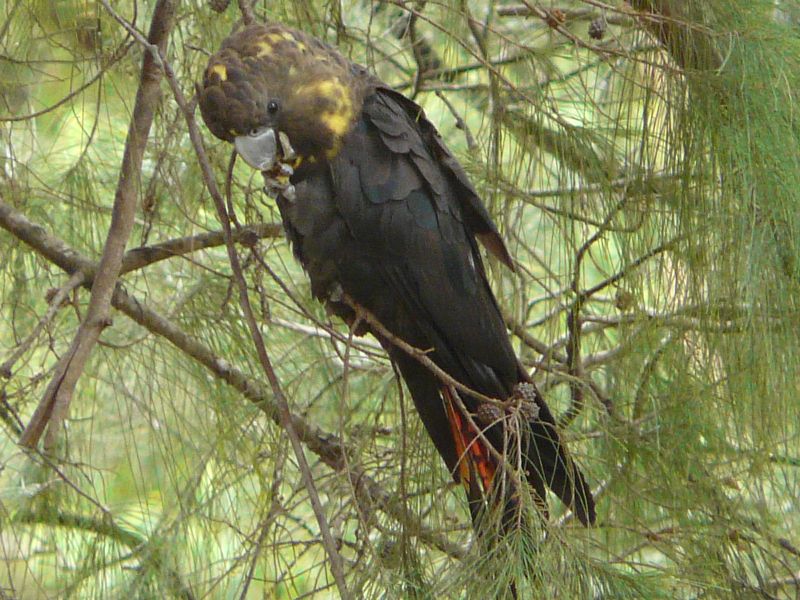
A black cockatoo, as it normally appears. Photo: Ian Fraser
The cockatoo isn’t the first case among Canberra’s birdlife. Farley notes a magpie coloured a mix of grey and yellow has been spotted repeatedly in Symonston, near Hindmarsh Drive, over the past six years.
“You often see him just pottering about with his fellows along the roadside there,” she says.
Farley says there’s no evidence that the condition is occurring more often, either.
“Canberrans can be really comfortable; they don’t have to worry about this bird. From the photos, it’s very healthy, its feathers are all plumped up, and it’s looking proud of itself. And it’s been seen and photographed flying with other yellow-tailed black cockatoos.”
Research does suggest it tends to strike the darker-coloured birds more than lighter species, however.
“It does tend to be those three colours of white, grey and yellow,” Farley says.
“Other people will see parrots with weird colours, but that’s not leucism at all – that’s more likely to be either a natural hybridising between different closely related species, or an aviary-developed variation.
“But there’s some evidence, particularly from the US and UK, that it often tends to affect the birds that are very dark in colour anyway, so species like the magpie, raven and black cockatoo.
“And because this one’s big and normally black, and now yellow, it really jumps out at you.”
Canberrans are encouraged to report sightings of the yellow cockatoo on Nature Mapr.