
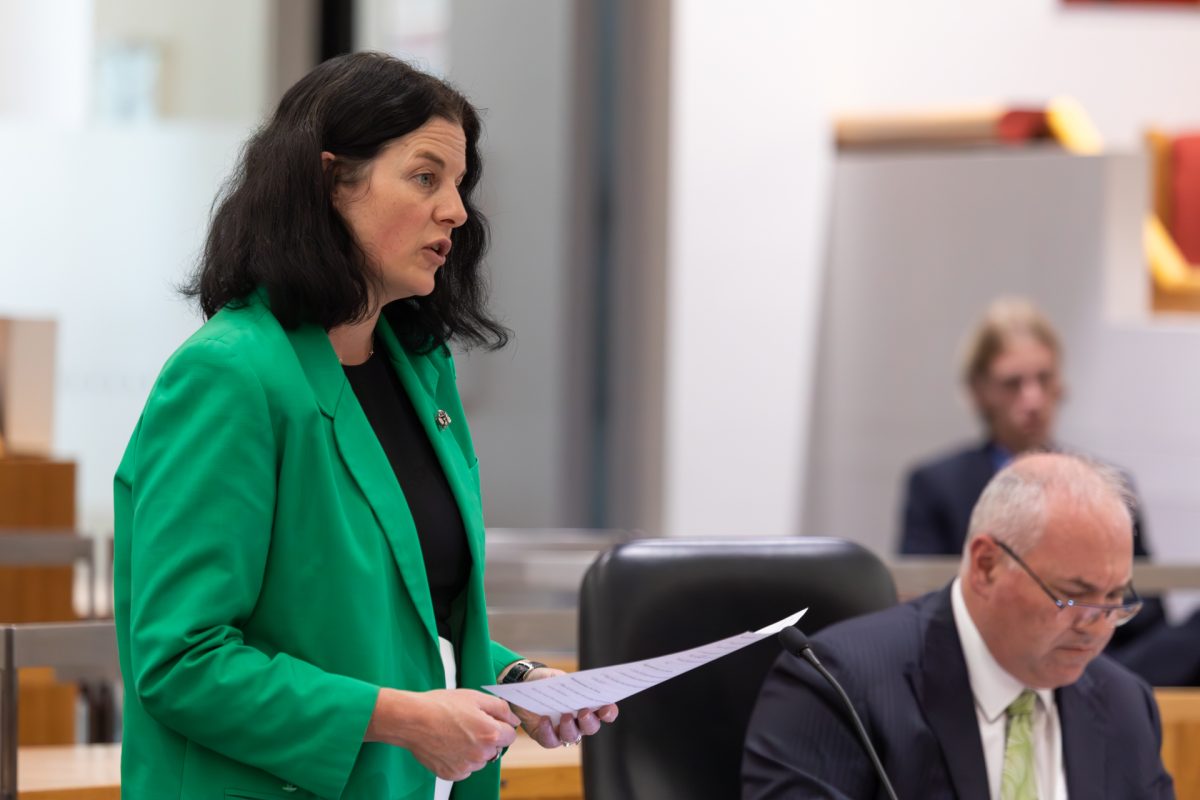
Committee chair Jo Clay says an independent view of the situation will be valuable. Photo: Michelle Kroll.
At first blush, paying economist Saul Eslake $121,000 to review the ACT’s finances seems a waste of his time and our money.
His report runs the risk of sitting on a shelf gathering dust with all the rest if Treasurer Chris Steel finds his recommendations unpalatable.
These are likely to include increasing taxes or cutting spending (read services), or both, all of which have their opponents.
The chair of the Select Committee inquiring into the ACT’s fiscal position, Jo Clay, acknowledges this risk, but says just obtaining a view independent of government will be worthwhile, especially from an economist of Mr Eslake’s experience and reputation.
The inquiry itself is a political response to last year’s billion-dollar Budget deficit, with the strange bedfellows of the ACT Greens and Canberra Liberals both alarmed at the Territory’s deteriorating fiscal position and not accepting Mr Steel’s version of events.
The two may come at the finances from different perspectives, but it is in their interests to try to get to the bottom of the situation outside of the bureaucracy that has such a long association with Labor governments.
Ms Clay, tiptoeing around her role as committee chair and Greens MLA, believes commissioning an “accurate picture” of the financial position and what can be done to improve it will have enormous benefits.
Certainly, the inquiry will have much more clout if its findings are underpinned by such a report.
For the public, limited to government reporting framed by Treasury and the response from an underresourced opposition and crossbench, Mr Eslake’s report will be eagerly awaited.
External reports do emerge, such as those from the ratings agencies and last week the International Monetary Fund, which covered the states and territories but still resonated for the ACT.
But the Labor Government generally plays down warnings, cherry-picks data and reassures everyone the balance sheet and economy are strong, and the growing debt is manageable.
Yet structural problems remain as health and education consume bigger chunks of the budget and the government continues to implement its ambitious infrastructure program.
According to the Budget Review, the government’s repair job is working and the ACT is on the way back to surplus, not that this is a crucial goal in itself.
But it holds out the promise of a crisis averted without really dealing with the underlying problems.
And of course, the Labor surplus has been a mirage for many years.
It will be interesting to see what Mr Eslake makes of the ACT’s special situation as a small jurisdiction with a narrow revenue base and its reliance on Commonwealth funding.
For example, can it deliver the services and facilities its citizens demand under its current structure?
Does it need more Commonwealth help to negotiate a temporary period of updating infrastructure, given the ACT is now well into its second century?
Or does there need to be a reappraisal of Commonwealth funding? Mr Steel would certainly argue that the ACT is consistently dudded when it comes to GST payments.
But Ms Clay notes that the GST is no longer the growth tax it was touted to be, and would be looking, as a Green, for some vindication of her party’s stance on revenue options.
No doubt all parties will take what they want from Mr Eslake’s report, and it will come down to the increasingly fluid dynamics in the Assembly.
Ms Clay says Labor’s minority position and the potential for non-traditional alliances mean the government won’t easily dismiss Mr Eslake’s recommendations.
After the recent revelations of coalition talks between the Liberals and the Greens, one should not make any assumptions about the year ahead.
Mr Eslake’s findings and the committee’s final report are due in July, after the Budget is handed down in June.
It would be best if the government took both seriously and the Assembly worked together to put the Territory on a long-term path to financial sustainability.