

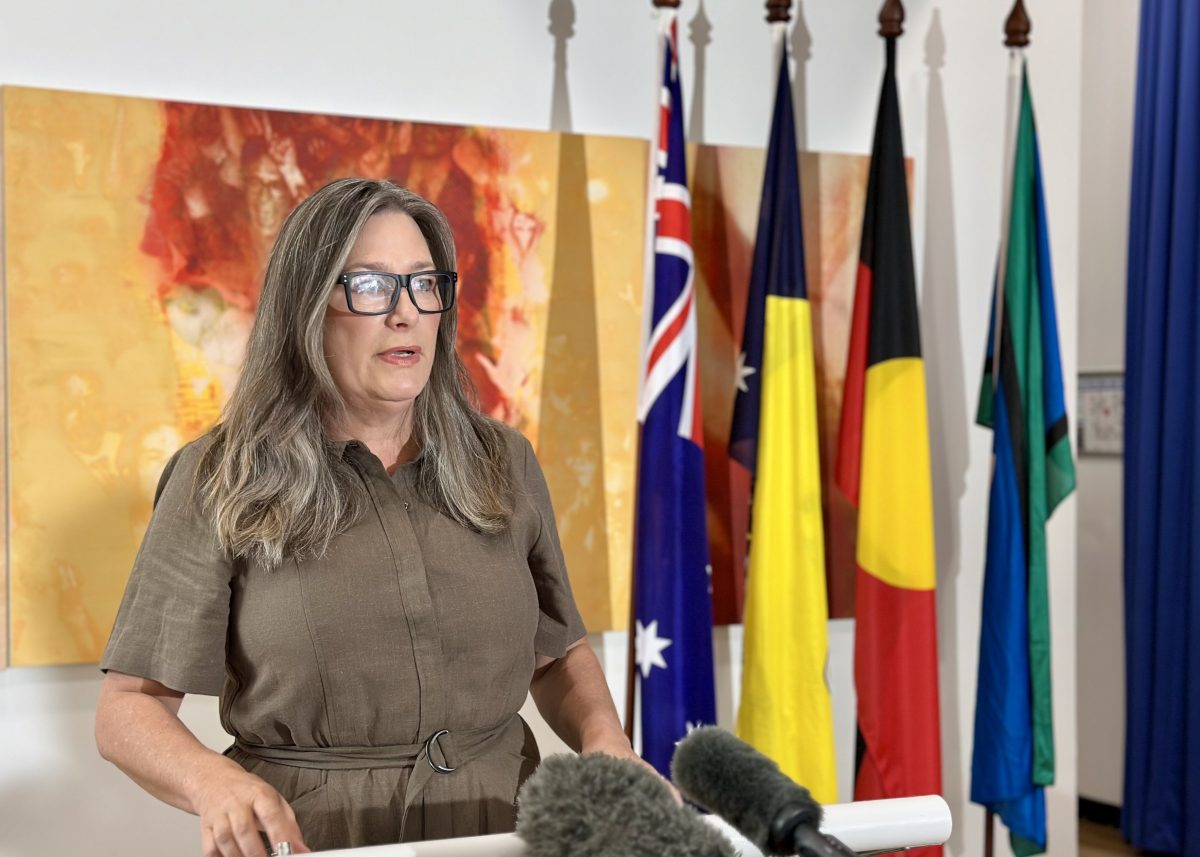
Education Minister Yvette Berry could have an easy win but her reflexive response is too often negative. Photo: Region.
If ever there was a place where language education would be supported, you’d think it would be the national capital.
Diplomatic missions everywhere, the seat of government and the public service, with agencies such as the Department of Foreign Affairs and Trade and security agencies in need of multilingual staff.
Canberra itself has also become much more multicultural over the years, with many more languages being spoken here than before.
But when it comes to filling a service gap that would keep public school students, in particular, studying their chosen language at little cost to the budget, the ACT Government has baulked.
With an inflexibility that had become a pattern, Education Minister Yvette Berry has simply said no to a solution, offering no proper explanation, except perhaps citing the long-running struggle to recruit and retain language teachers.
The issue arose when the cash-strapped CIT decided this year to scrap its commercial training arm, CIT Solutions, which was running a languages program it had taken on from the private Canberra Academy of Languages, after co-owner Frank Keighley sought to secure its long-term future.
That left some Year 10 students who wished to continue studying their chosen language at an ATAR level, but whose local college could not cater for them, facing an out-of-area enrolment, or navigating a double enrolment, something that would involve lots of travel and be so time-consuming as to be impractical, as well as being disruptive to other classes.
The other option from the Directorate was to enrol in a distance program, again not really practical for language study.
The Board of Senior Secondary Studies has a specialist education provider, but it only caters for Mandarin.
Parents and Mr Keighley say the Directorate should simply pick up the CIT Solutions program.
Students, and probably their parents, are happy to travel outside school hours to a centrally located venue.
Some might think this is an issue that doesn’t involve that many students, so why should the Directorate get involved?
Well, as the main provider of education in the ACT, the Directorate’s job is to offer a curriculum that includes languages across all its schools, where possible.
The Directorate has also spent the past two years developing an ACT Language Study Action Plan.
Now would be a good time to actually take some action and bolster an area of education that suffers from recruitment and retention issues by pooling resources with an after-school program to plug gaps across the system at ATAR level.
A new school to replace on-campus teaching during the day is not being proposed, but a program to augment the current arrangements and prevent students from dropping out of their studies, as is the case in NSW, Victoria, Queensland and South Australia.
Mr Keighley estimates it would cost about $250,000 a year to run, nothing in the context of the education budget, but fees could be charged if cost recovery was an issue.
The broader issue involves choice and equity. Without some sort of backstop, the study of languages comes down to chance – wherever you live and what teachers may be available at the time.
Ms Berry, despite whatever “action plan” is on the website, is abdicating the ACT’s responsibility for these students by not adopting a more systemic approach to languages that could provide more certainty.
That in itself might encourage more students to continue with a language, thereby building demand and capacity.
Ms Berry has cited the difficulty of finding teachers, saying they can’t just be magicked up, but this only supports the idea of making the most of the resources available.
She may be concerned about a cost that could grow or the Directorate taking on something that could become a burden.
Maybe she has been advised that there are too few students for such a commitment. Maybe languages are considered a soft area of study or even something for the elite. Or perhaps there are concerns that – shock, horror – private school students might also find such a program useful.
Whatever the reasons, the minister does not always have to take the Directorate’s advice, and this decision only weakens the public system and drives families to private schools.
This is something the public system can ill afford and is a disservice to those families who have no choice but to send their children to public schools.
This should have been an opportunity for Ms Berry not only to help families in need but also to ensure a better future for the study of languages in the ACT.
A ready-made model is available, and the cost is minimal. It should be an easy win.
Instead, it is another story about the shortcomings of ACT public education and a minister whose reflexive response is too often negative.
It took years before any acknowledgment of the literacy and numeracy problems in ACT schools, which eventually led to an inquiry that articulated the issue and resulted in a reform program.
The languages issue is nowhere near as great, but it is symptomatic of a rigidity in ACT public education that is holding back its students’ full potential.