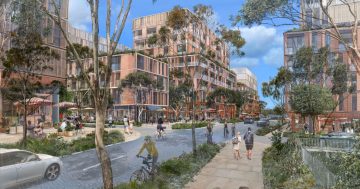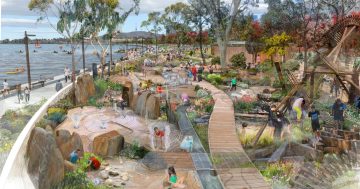

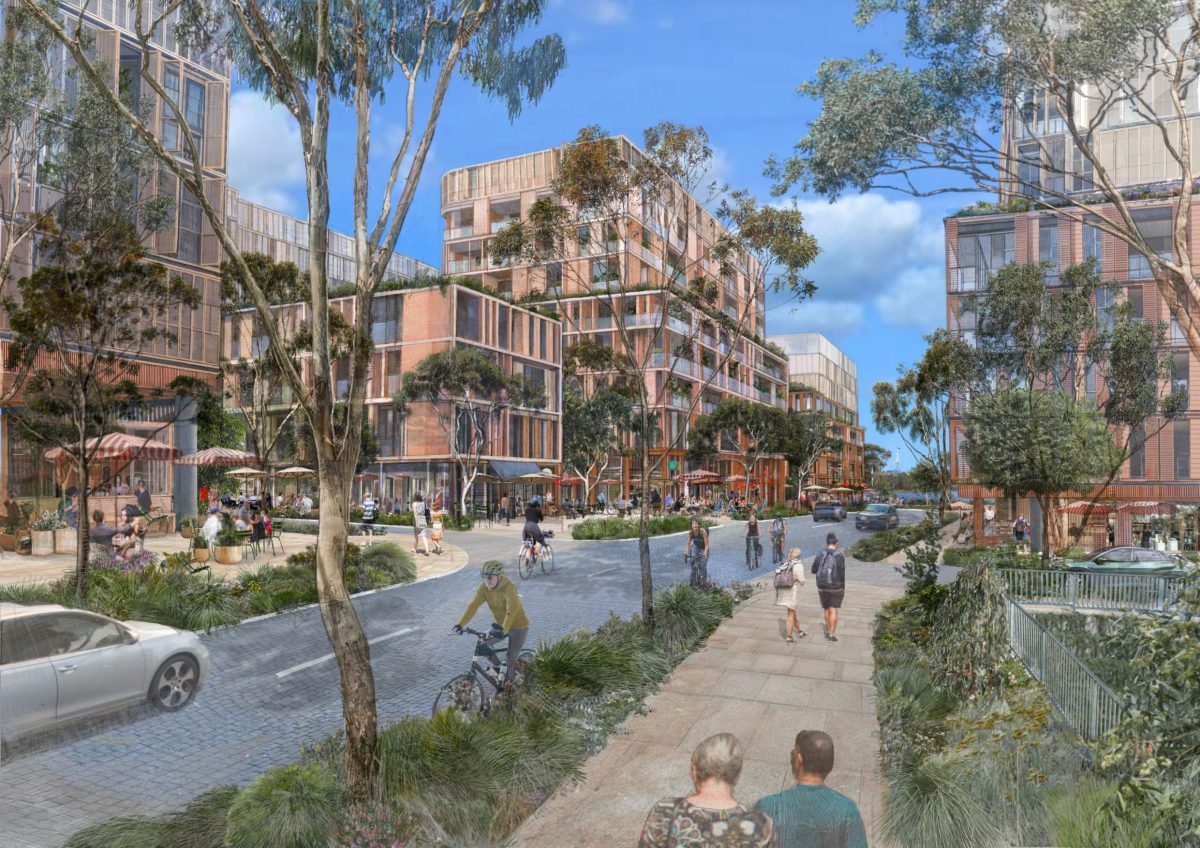
A place to live and play. A streetscape view looking towards Lake Burley Griffin. Images: ACT Government.
Community concerns about density and building heights in the planned Acton Waterfront Neighbourhood can be ameliorated through good design, according to City Renewal Authority CEO Craig Gillman.
The CRA is planning about 1400 dwellings across the six hectares of developable land at West Basin, housing 2000 to 3000 residents, along with shops, offices and a hotel.
Feedback in the Listening Report from its recent consultation shows a clear preference for parks and open space, lines of sight to the lake, and easy, direct public access to the water’s edge.
But there was only moderate support for housing density, with just 32 per cent of respondents viewing “enough homes and activity” as essential to creating a lively neighbourhood.
Building heights were also a concern, with 65 per cent suggesting varied building heights were important or essential to making street areas vibrant, and others opposed to high buildings.
Eight-storey buildings are planned along Commonwealth Avenue, south of Parkes Way, reducing in height towards the lake.
Others were concerned about 17-storey buildings on Parkes Way creating a visual barrier that blocks the northern sun and cuts off the city’s connection to the lake.
But Mr Gillman said the neighbourhood could achieve the 330 people per hectare desired for vibrancy and still meet community expectations for sunny streets, views, and access to the water.
He said slender buildings oriented north-south would allow plenty of sunlight into apartments and streets and enable cross-ventilation for fresh air.
“It also means the impact on the public realm is lower because the overshadowing is nowhere near as great,” Mr Gillman said.
Slender buildings would also help protect the vistas towards the Brindabellas and Parliament House.
Mr Gillman said the feeling about varying heights to provide variety and texture was quite strong.
“We’ve just got to refine our design principles based on this feedback, and we will continue to do so,” he said.
Along Parkes Way, the goal was to create an urban environment that rises from the lake, but with a good setback from the shore.
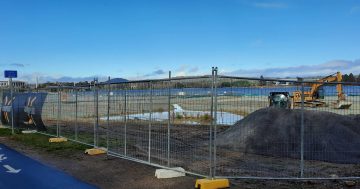
The new Ngamawari Park, to be built this year, would occupy at least a 50-metre-wide space from the lake edge before the neighbourhood begins.
“We do want to do that well, but also create an amphitheatre effect as the neighbourhood rises to meet the city,” Mr Gillman said.
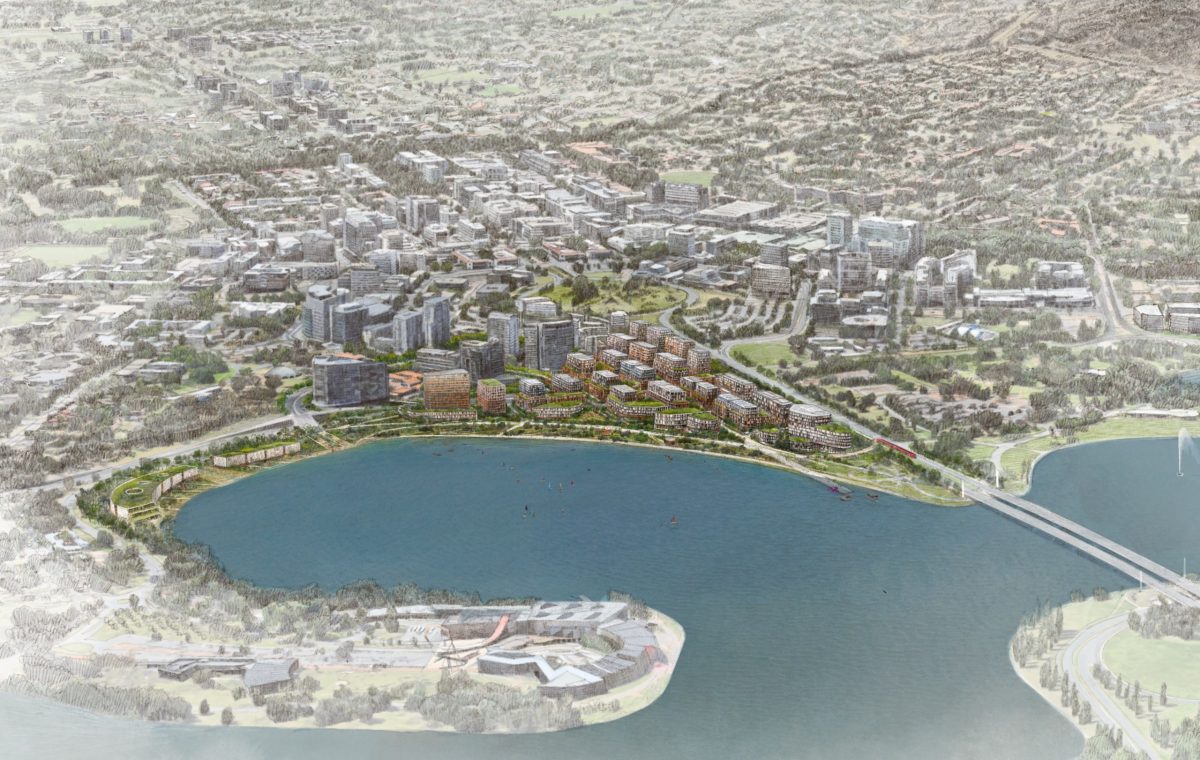
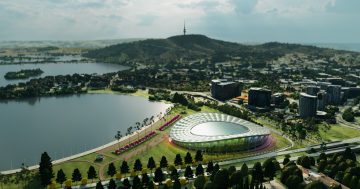
An aerial artist’s impression of the future Acton Waterfront. Building heights are designed to create a lively precinct – lower near parks and open spaces and taller near transport routes and future light rail stops.
From a developer’s point of view, projects will need to stack up.
Mr Gillman said that feasibility work was underway, leading to a market release next financial year in a two-stage process.
“We need to have some understanding of the project’s feasibility, and it will change as we refine our design principles. That work will go right up until we go to market,” he said.
But Mr Gillman said it was important not to be too prescriptive about what developers could do, so there was scope for innovation and delivering something different.
Overall, the CRA was pleased that more than 50 per cent of people supported its vision for a lively people-centred neighbourhood.
Feedback indicated that Acton Waterfront should be a destination, not just a place for residents, with plenty of shops, restaurants and cafes.
Fifty-seven per cent rated this feature as essential to achieving an authentic Canberra lifestyle at Acton Waterfront.
That has the potential for friction between residents and visitors, especially over noise, which the design principles note must be managed.
But Mr Gillman sees the non-residential components as essential.
“Part of the area’s drawcard to be a resident there will be its energy. It is vital,” he said.
“That’s why people choose to live in Braddon.”
Mr Gillman acknowledged there would be some challenges and trade-offs, but having that attraction was really important.
Respondents (70%) also wanted Acton Waterfront to be a place where it was easy to walk, cycle, and connect to the city.
Affordability was also important, not just in the range of housing, but also in food offerings.
Mr Gillman said it was hoped to have engaged a development partner or partners by 2028, with a 30,000 sqm world-class park in situ and light rail running as the neighbourhood started to develop.