
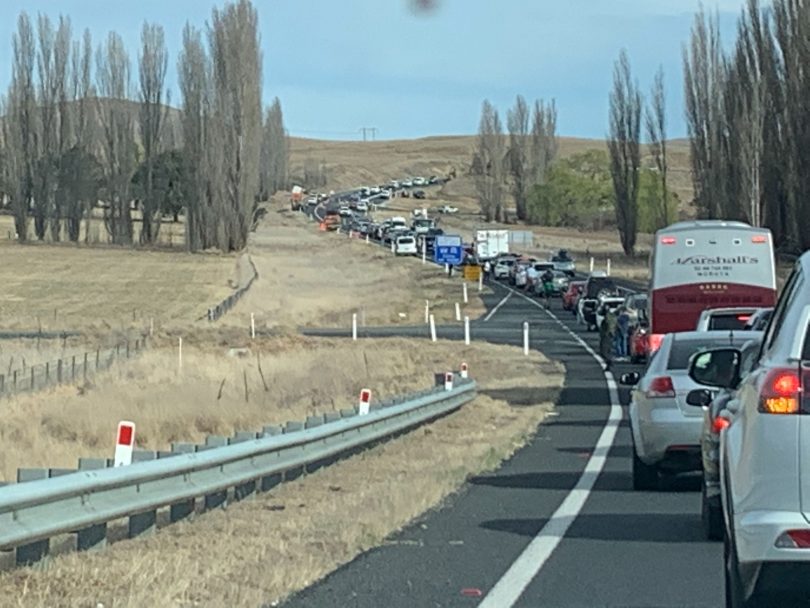
AAA wants to see no-blame investigations into road deaths to help understand why the toll is so high. Photo: Region.
Australia’s road toll has risen at an alarming rate and the nation’s peak motoring body wants the Federal Government to do something about it – namely, launch no-blame investigations into road fatalities.
No-blame investigations are safety-focused inquiries, used most commonly for aviation, rail, and marine accidents.
Rather than assigning fault or liability, no-blame investigations aim to identify underlying system failures and provide safety lessons. They encourage open reporting by removing the fear of punishment.
The Australian Automobile Association (AAA) is today (23 February) calling on the government to be proactive in leading changes to road safety management, saying the current strategy isn’t delivering the desired results.
The National Road Safety Strategy 2021-30 began in January 2021 with the aim of halving national road fatalities through the decade to 2030.
Governments at all levels are working together through the strategy to change the road transport system to prevent deaths and serious injuries on our roads.
But five years in, it has instead delivered an ongoing increase in road deaths, and some of its targets remain unmeasurable.
The strategy is under review, and the AAA wants to see changes implemented as a result and for the Federal Government to step up compared to other jurisdictions.
The 12-month road toll rose compared to the previous corresponding period for the 32nd consecutive month.
AAA managing director Michael Bradley is pointing out to the government that the last time the 12-month road deaths total was lower than in the previous corresponding period was May 2023.
“Since the National Road Safety Strategy 2021-30 began in January 2021, crash fatalities have risen by 19.7 per cent,” he said.
“The Federal Government must use this review to correct this year’s long surge in road trauma by enhancing the Commonwealth’s role in transport safety.
“There is plenty of speculation about why road deaths are rising nationally and why they are worse in some states than others. But we need more than guesswork to curb this growing crisis.”
For the AAA, the starting point to addressing the worsening road toll is to gather “hard facts” that help policymakers understand what is causing it to rise in the first place.
It is calling on the Commonwealth to extend its powers to conduct no-blame investigations of transport fatalities beyond aviation, rail and maritime incidents.
“The government could begin with a targeted pilot focusing on one of the road safety issues of greatest concern, such as fatalities involving heavy vehicles, pedestrians or e-mobility devices,” Mr Bradley said.
“Learnings from a pilot project would not only show us how no-blame investigations can help identify the underlying causes of road crashes, but also what could be done to stop more deaths and injuries occurring in the future.
“Reducing road trauma requires better roads, regulatory change and public education campaigns. All of these would be better targeted, more evidence-based, and more effective if informed by a national no-blame investigation approach.”
In the 12 months to 31 January 2026, Australia’s road toll rose by 0.7 per cent to 1313 fatalities.
The ACT saw a 20 per cent increase, rising from 10 to 12 during that period.
Crash fatalities rose particularly sharply in NSW (up 17.3 per cent) and Tasmania (up 36.4 per cent).
Deaths among vulnerable road users (people not travelling in a car, bus or truck) rose by 2.2 per cent in the 12 months to 31 January 2026.
There were 517 vulnerable road user fatalities – 199 pedestrians, 269 motorcyclists and 49 cyclists.
Motorcyclist deaths, however, fell 6.9 per cent from the previous corresponding period, while pedestrian deaths rose 13.7 per cent and cyclist deaths rose 16.7 per cent.
The AAA’s call follows a recent report from Roads Australia, Showcasing Safe Movement & Place, which revealed that road fatalities have increased over the past five years rather than declining, putting Australia significantly behind its road safety targets.
That report shows road fatalities are not confined to regional highways and freeways.
About one in four road deaths occur on local streets, while in Australia’s cities, 40 per cent of fatalities happen on high-capacity urban roads.
Roads Australia chief executive officer Ehssan Veiszadeh said the latest figures underscore an urgent need to rethink how urban streets are designed and managed.
“This is a critical moment to ask how safe our urban roads really are, and if we’re doing enough to make them safer,” Mr Veiszadeh said.
“At 50 km/h, a pedestrian struck by a vehicle has around a 90 per cent chance of death. At 40 km/h, the risk drops to approximately 40 per cent, and at 30 km/h, to just 10 per cent.
“Even small reductions in speed can save lives. Lower speeds dramatically improve a person’s chance of survival and allow motorists to stop and avoid a crash entirely, making streets safer for everyone, especially pedestrians, cyclists and children.”