
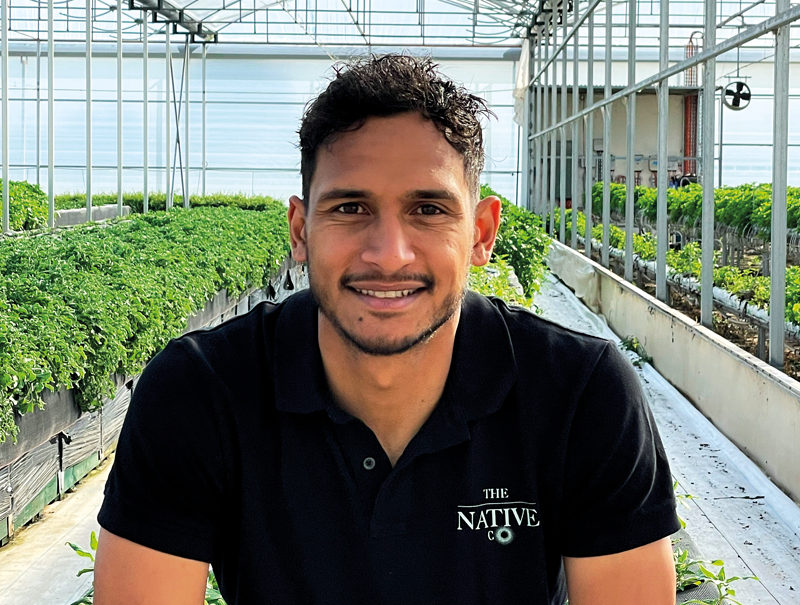
Former AFL player Marlon Motlop wants stronger protection of Indigenous Cultural Intellectual Property in the Australian native food industry. Photo: Supplied.
Fancy a dash of Kakadu plum in your smoothie, or infused through a favourite wine?
What about some rock fuchsia flowers added to your salad? Warrigal greens for your soup anyone?
Australian native foods are increasingly being included in local dishes and are attracting growing interest from retailers and manufacturers, as well as emerging as a sought-after exported product.
The First Nations native food industry was worth $81.5 million in the 2019–20 financial year and was on its way to doubling by this year.
A new report just released points out that, far from niche culinary novelties, these foods are part of an industry rooted in 60,000 years of Indigenous history.
The study – already on the desks and inboxes of policymakers in Canberra – stresses the importance of traditional knowledge protection in the Australian native foods industry and calls on the governments to implement specific safeguards.
First and foremost, the report published by Nuffield Australia calls for increased First Nations leadership in the rapidly growing industry.
“Underpinning many of the Aboriginal-owned organisations working within agriculture and food is a rich history and interconnected relationship with land, plants, animals and people encompassed through Aboriginal and Torres Strait Islander lore and customs,” the report states.
“This is also known as ‘cultural significance’. Native produce holds vital information and plays a pivotal role within Aboriginal culture.
“This includes detailing what specific foods are utilised for, when and what can be harvested, which community members hold knowledge and importantly, what can be eaten.
“This information is part of what in today’s world is better known as Indigenous Cultural Intellectual Property (ICIP).
ICIP refers to the rights that Aboriginal and Torres Strait Islander peoples hold in relation to protecting and controlling their cultural heritage, traditional knowledge and cultural expressions.
The report notes that this includes languages, stories, art, music, dances, ceremonies, symbols, ancestral remains, sacred sites and knowledge of native foods and plants.
The most recent Indigenous Business Snapshot from Melbourne Business School indicates First Nations native food businesses contribute more than $16 billion to the Australian economy, employ 116,795 people and pay $4.2 billion in wages.
Nuffield Australia awards scholarships each year to primary producers in Australia for travel and research around the world.
Former Port Adelaide AFL footballer Marlon Motlop is the latest scholar to release a report of his studies, after delving into how Australian native foods connect people, culture and country.
A proud Larrakia/Gulumoerrgin, Kungarrakany Erub/Darnley man, Mr Motlop has used his report to offer practical steps to ensure the knowledge systems and cultural practices involved with these foods are respected and protected.
“The role Australian native foods play from a cultural perspective is a pillar in the lore of our Aboriginal and Torres Strait Islander people,” he said.
“Major challenges remain for Indigenous-led native food businesses, including risks of cultural exploitation, barriers to market access and the need for stronger protection of Indigenous Cultural Intellectual Property.
“We’re talking about the protection of Aboriginal and Torres Strait Islander peoples’ rights to their cultural heritage, including knowledge, stories and creations.”
Mr Motlop found the industry is growing quickly, with more people interested in its unique flavours and health benefits.
And he argues that First Nations knowledge and cultural protocols are essential for growing and sharing these foods in a way that respects culture and country.
His scholarship saw him visit Aboriginal Land Councils and Corporations across northern Australia, as well as travel to North and South America, Europe, Singapore and New Zealand to meet with other Indigenous farmers and food business owners and learn more about supply chains and markets.
Mr Motlop is himself an owner of an Australian native foods business, Native Kitchen Australia, and insists that native foods are more than ingredients, but are also stories, traditions and a bridge between cultures.
The report makes strong recommendations to address the challenges facing the industry and how to advance it sustainably and ethically.
These recommendations include:
- Strengthen Intellectual Property and Traditional Knowledge protection
- Build consumer trust through authentic branding
- Greater investment in research and development
- Secure sustainable supply chains through capability and capacity building for First Nations agribusiness
- Increased capital investment in First Nations agriculture businesses
- Majority share of First Nations-owned bush food businesses
- Culturally safe Aboriginal and Torres Strait Islander governance structures for First Nations businesses in the native foods sector.
“This report is about more than food – it’s about respect, opportunity and working together for a better future,” Mr Motlop said.